Connected but Divided
Affective Publics and the Clash of Communities on Croatian Reddit in the Context of the 2024 Elections
Digital platforms increasingly function as informal arenas of civic engagement in which citizens negotiate belonging, express social identities, and participate in public debate. This study examines Croatian Reddit communities as emerging digital publics that reflect broader patterns of social cohesion, exclusion, and participatory inequality. Drawing on theories of virtual communities and networked publics, this paper explores how Croatian Reddit communities communicate, construct boundaries, and express collective identities through sentiment patterns during a moment of heightened social salience: the 2024 Croatian parliamentary and European Parliament elections. Using a dataset of 11,503 Reddit comments collected from March to June 2024, we apply network analysis, sentiment analysis, and topic modelling to explore how communities interact, differentiate themselves, and confront one another. Findings show that although communities discuss the same socially relevant topics, they differ in emotional climates, reflecting affective dynamics characteristic of contemporary digital publics. Structural segmentation is accompanied by varying levels of negativity, which may discourage participation among less assertive users and reproduce existing inequalities in civic engagement. At the same time, a small group of “connectors” interacts across multiple communities, indicating a limited yet important potential for integrative communication in a fragmented digital environment. This study conceptualises these dynamics as a “clash of communities,” in which distinct groups remain separate yet continually engage in emotionally charged encounters. The findings highlight the importance of fostering inclusive communication norms, and recognising emotional dynamics as key factors shaping social cohesion and democratic participation in contemporary digital settings.
virtual communities, user comments, communication, clash of communities, Reddit
Original scientific paper · Medijska istraživanja 32(1), 2026, pp. 31–54 · DOI 10.22572/mi.32.1.2 · Received March 2026
Introduction
Digital platforms have become important spaces where citizens articulate viewpoints, negotiate social identities, and participate in public debate outside traditional institutional contexts. As informal public forums (Habermas, 2022), virtual communities increasingly complement or even replace conventional forms of civic engagement, particularly among younger and digitally active groups who are often distanced from formal political processes. Virtual communities are not merely digital replicas of offline groups, they represent complex sociotechnical environments where individuals negotiate identity, belonging, communicative norms, and emotional expression (Baym, 2010). Rather than serving merely as channels for information exchange, online spaces constitute networked publics in which communication practices shape social boundaries, emotional expression, and patterns of participation (boyd, 2011; Papacharissi, 2015). In this context, virtual communities represent important sites for examining how contemporary public discourse is structured and experienced. Online discussions not only reflect citizens’ positions on socially relevant issues but also reveal how they perceive their role in the community and the extent of existing social divisions. Emotional features of online communication can encourage or discourage certain groups from participating, thereby reinforcing social inequalities in public engagement (Papacharissi, 2015; Ziegele et al., 2018). Digital forums, including social networks, dedicated platforms such as Reddit, and news comment sections, enable users to interact directly, share viewpoints, and participate in public debates without traditional media gatekeepers (Kunić, 2024: 32). In this sense, such platforms have reshaped democratic discourse by broadening who can participate and how public discussion unfolds.
A substantial body of research has examined online political communication through the lens of polarisation, often conceptualising digital environments as fragmented into ideologically homogeneous “echo chambers” (Cinelli et al., 2021). However, more recent scholarship challenges this assumption, demonstrating that exposure to diverse viewpoints does not necessarily reduce polarisation and may instead intensify disagreement and reinforce group identities (Bail, 2021; Benkler et al., 2018). This suggests that fragmentation in digital environments should not be understood solely as ideological isolation, but as a more complex phenomenon shaped by patterns of interaction, identity performance, and emotional communication.
Among these platforms, Reddit stands out as a constellation of semi-autonomous virtual communities structured through subreddits, each with its own norms, communicative culture, and identity markers. It is an example of a networked public (boyd, 2011), where participation is organized around shared interests, attention structures, and evolving cultural practices. This study examines Croatian Reddit communities as an empirical case of such dynamics during a period of heightened social salience: the 2024 parliamentary and European Parliament elections. In the Croatian media context, shaped by a hybrid media system and relatively limited forms of participatory engagement (Peruško et al., 2020), Reddit offers a less institutionalised and more community-driven space for observing public discourse. In this paper, Reddit is analysed as part of a broader hybrid media environment in which audiences do not act merely as recipients of political information, but as active agents who, through communicative practices, produce interpretative publics beyond professionally moderated media institutions. Political events such as elections provide particularly valuable contexts for examining these dynamics. Elections are not treated as the primary object of analysis but rather as a sociological stress test that makes otherwise latent patterns more visible. Such moments intensify collective identity (Castells, 2012), make interaction norms more salient (Papacharissi, 2015), sharpen boundary-making practices (boyd, 2011; Lamont and Molnár, 2002), and provoke affective alignment or disagreement across groups (boyd, 2010).
The aim of this study is to examine how virtual communities on Croatian Reddit function as spaces of informal civic participation during a period of heightened social relevance. This study draws on research on networked publics and virtual communities to understand online communication as a form of identity performance and collective meaning-making rather than merely ideological conflict. Rather than assuming ideological polarisation as the primary outcome of online interaction, the study contributes to research on digital public spheres, networked publics, and participatory communication.
Networked Publics and Virtual Communities in Digital Communication
Digital communication environments create networked publics in which interaction is organized through technological affordances, visibility structures, and participatory practices (boyd, 2011). These environments transform the public sphere by enabling decentralized participation and expanding opportunities for identity performance and collective expression (Papacharissi, 2015). Rather than a unified deliberative space, the digital public sphere is characterized by fragmentation, overlapping audiences, and multiple communicative arenas. Virtual communities are social formations produced through ongoing interaction, symbolic practices, norms, and emergent patterns of meaning. They are not predetermined by platform architecture, but instead dynamically constructed through everyday communicative actions (Wellman and Gulia, 1999). Examining the sense of community in online environments involves the concept of imagined communities, which are not bound by physical locality, as well as the distinction between virtual and real communities and the conditions under which online groups can be considered genuine virtual communities (Marjanović, 2025).
Participation is a key aspect of the success of such virtual communities and depends on the motivation of their members. Posting content and replying to messages can therefore be considered forms of participation in online forums (Kunić, 2024: 76). These communities unite individuals who share common values, goals, and identities, often offering a sense of belonging to those excluded from mainstream media due to factors like age, race, or gender. From a broader perspective of the public sphere, such communities can also be understood as forms of counterpublics that emerge alongside dominant communicative spaces, offering alternative arenas for expression and identity formation (Fraser, 1990). This highlights the importance of examining not only structural segmentation, but also the normative and symbolic dimensions of participation within digital environments.
According to Marwick and boyd (2011), a networked audience refers to a mix of personal ties and broader publics connected through digital platforms, where users are not just passive recipients but an active part of a dynamic, interconnected online environment. Unlike the anonymous broadcast audience, the networked audience often includes familiar individuals, making it simultaneously personal and public with uncertainty of its full composition. As Habermas (2022) points out, the digitalisation has expanded and fragmented the public sphere, giving rise to semi-public communication spaces where individuals act as authors without editorial mediation. Research shows that even when virtual spaces like subreddits revolve around identical topics, they develop distinct communicative cultures, differentiating themselves in emotional intensity, linguistic style, resource preferences, exclusivity, and cross-community mobility (Soliman et al., 2019: 259–260). Some communities encourage cross-posting, while others enforce strong internal boundaries (Soliman et al., 2019: 262–263). This aligns with the concept of networked individualism (Wellman, 1999), where individuals shape their identity. Prinster et al. (2024: 33) highlight that virtual communities must be understood not only structurally but also subjectively. Users have varying degrees of psychological belonging, influence, and emotional safety depending on the subreddit. Some subreddits cultivate strong identities and commitment, while others function merely as informational repositories. Their identification of five community archetypes (topical Q&A, learning communities, social support networks, content creation hubs, and affiliation-based communities) illustrates how communicative environments differ across Reddit (Prinster et al., 2024: 33).
Network structures influence how communities interact and how information circulates. Some users act as bridges between otherwise segmented groups, facilitating cross-community interaction and exposure to diverse perspectives (Wellman, 2001). These actors play an important role in maintaining connectivity within fragmented communication environments. Rather than assuming ideological polarisation as a primary outcome, this study conceptualizes online communication as structured through processes of segmentation, boundary formation, and interaction patterns that may contribute to fragmentation of the digital public sphere. The concept of the connector plays a pivotal role in understanding how virtual communities can bridge social, cultural, and geographical boundaries. Connectors are individuals within a network who are particularly motivated to form and maintain ties with people outside of their immediate social group. They tend to overlook perceived dissimilarities and seek novelty in engaging with others, making them key agents of intergroup communication and understanding (Kotowski and dos Santos, 2010). In virtual environments, connectors facilitate the flow of unique information across weak ties, linking otherwise disconnected groups and enhancing mutual understanding. However, cross-community interaction does not necessarily lead to consensus or integration. Research shows that exposure to diverse viewpoints may instead reinforce disagreement and intensify identity-based divisions (Bail, 2021). From an agonistic perspective on democratic communication (Mouffe, 2005), interaction between distinct groups can be understood as an ongoing process of contestation, where differences are expressed rather than resolved.
Affective Dynamics of Online Political Communication
Periods of heightened political relevance, such as elections, tend to intensify the underlying dynamics of virtual communities. Prior research shows that community boundaries become more salient as groups reaffirm symbolic distinctions and shared norms (Lamont and Molnár, 2002). During such moments, users also deploy identity markers more actively, engaging in discursive practices that reinforce collective belonging (Castells, 2012). At the same time, conflict increases, aligning with Mouffe’s (2005, 2013) view of agonistic confrontation as a constitutive feature of pluralistic publics and with Gaudette et al.’s (2020) finding that contentious issues amplify identity-protective communication on Reddit. Despite clearer boundaries, cross-community engagement may accelerate, as networked publics create overlapping contexts that draw users into shared discussions (boyd, 2011) and as major political events stimulate movement between subreddits (Soliman et al., 2019; Prinster et al., 2024). Finally, emotional expression peaks, consistent with research showing that affect is heightened in digitally mediated publics during salient events (Papacharissi, 2015; Cinelli et al., 2021). Together, these patterns position elections not merely as political contests but as sociological moments that expose the communicative, emotional, and boundary-making mechanisms through which virtual communities reproduce themselves. Gaudette et al. (2020: 4) show how emotionally charged topics amplify group cohesion through shared narratives and “othering,” while Soliman et al. (2019: 259) demonstrate that major political events reorganize participation and rhetorical patterns.
Recent scholarship suggests that digital interaction is often shaped less by ideological isolation than by identity performance, emotional communication, and networked interaction patterns (Brüggemann and Meyer, 2023; Barberá, 2020). Brüggemann and Meyer (2023) recently proposed an analytical framework for discursive polarisation, linking ideological and affective polarisation with the content-related and structural dimensions of communication. Whether polarisation harms society and democracy depends on its degree: if it is temporally and socially limited and restricted to specific topics, disagreement and conflict may merely be part of the democratic process. However, if left unchecked, polarisation may ultimately fragment the democratic public sphere (Habermas, 2006). Scholars such as Barberá (2020) have argued compellingly that, particularly on platforms such as Twitter, Reddit, or YouTube, the dynamics of polarisation are not primarily about ideological disagreements on issues but rather about antagonistic interactions with out-groups.
User comments, forums, and participatory platforms have long been recognized as important components of democratic discourse, enabling more diverse participation than traditional media allow (Ziegele et al., 2017). Reddit’s architecture — lack of user profiles, thematic organization, community moderation, longer posts — makes it a valuable environment for studying public communication (Cinelli et al., 2021; Freelon, 2015). Yet, research also notes uncertainty about whether users carry discussions across subreddits or remain confined to specific communities (Treen et al., 2022). As Mouffe (2005, 2013) argues, democratic publics are constituted through agonistic confrontation, not consensus, and distinct groups engage in ongoing struggles over meaning, identity, and legitimacy.
Methodology
This study investigates communication patterns of user comments on Croatian Reddit during the 2024 parliamentary and European Parliament elections. The starting point of the study consists of Reddit comments collected between March 14, 2024, and June 10, 2024, focusing on topics related to Croatian parliamentary elections and the European Parliament elections. The resulting dataset contains a total of 11,503 comments, with 40 variables recorded per post, such as publication time, post title, post text, as well as follower and engagement metrics. The study applies a mixed computational approach to identify structural and communicative patterns which would suggest the existence of specific communication communities and to see what their communication practices are.
In selecting the sample, comments were included based on predefined keywords searched in their titles or main text. Specifically, we relied on the following stems or partial words to capture various inflections: “izbor,” “glas,” “parlament,” “kampanj,” “debat,” “polit,” “hdz,” “sdp,” “most,” “politi.” These terms reflect key electoral themes (e.g., voting, parliament, campaigns, debates) and the names or abbreviations of political entities (HDZ, SDP, MOST), thus aiding the identification of a representative sample for the analysis. The resulting dataset was used for a machine-based content analysis, incorporating standard text preparation procedures such as tokenization and text cleaning. This process involved removing stop words, stemming, and lemmatization to facilitate term-frequency analysis (Ljubešić et al., 2020). Content analysis was used to generate word frequency distributions and to run topic analysis (LDA). To understand the character of the detected communities, we performed computational sentiment analysis on the comments within them. Each comment was assigned a positive, negative, or neutral sentiment score using pre-existing lexicons adapted for the Croatian language. We performed sentiment analysis using the NRC sentiment lexicon adapted for the Croatian language (Ljubešić et al., 2020), with a further robustness check using the CroSentiLex lexicon (Glavaš et al., 2012). We then analyzed the sentiment profiles of the largest communities and identified their most frequently used keywords to uncover differences in emotional tone and topical focus, reflecting public opinion or dissatisfaction (i.e., evidence of polarisation). All machine-based content analyses were conducted using R and its supporting ecosystem of text-mining packages, including tidytext, quanteda, and text2vec (Benoit et al., 2018; Silge and Robinson, 2016; Selivanov and Wang, 2016).
Apart from the combined content and sentiment analysis, our methodology also relied on network analysis to explore polarisation, discourse patterns, and sentiment shifts on Croatian subreddits. The network does not capture agreement or ideological alignment between users. Instead, it represents interaction proximity and co-presence in discussion spaces. The analysis therefore examines structural patterns of participation and community segmentation rather than ideological polarisation. For the network analysis, an extensive data preparation was undertaken. To ensure a high-quality network of human interactions, the dataset was filtered to include only valid author data. This involved removing comments with missing author names, posts from known automated accounts (e.g., AutoModerator), comments by deleted users, and entries where the author field contained malformed data, such as URLs. An undirected, weighted co-participation network was constructed to map user interactions. In our network, nodes represent individual authors. A connection (edge) was drawn between two authors if they both posted at least one comment in the same Reddit thread. The weight of this edge corresponds to the number of unique threads in which the two authors co-participated, signifying a stronger or more frequent relationship. To identify cohesive conversational clusters, we applied the Louvain community detection algorithm to the weighted network. The Louvain method is a widely used heuristic algorithm that identifies communities by optimizing a modularity score, which measures the density of connections within communities compared to connections between them. The analysis captures co-presence in discussions rather than direct interaction or agreement.
Three key metrics were used to analyze the network’s structure and the roles of its participants:
- Modularity (Q) quantifies the strength of the network’s division into communities. On a scale from −0.5 to 1.0, a value above 0.3 is generally considered to indicate significant community structure.
- Assortativity (r) measures the tendency of nodes to connect to other similar nodes. In this study, we calculated nominal assortativity based on each user’s primary subreddit (the subreddit in which they posted most frequently). A positive r indicates homophily, where users preferentially interact with others from their own subreddit.
- Participation Coefficient (P) is a user-level metric that measures how a node’s connections are distributed across different communities. A user with a P-score near 0 has links exclusively within their own community (a “local”). A user with a high P-score (approaching 1.0) has their links evenly distributed across many communities, identifying them as a “connector” linking otherwise disparate groups.
RQ1. How are virtual communities structurally organized in Croatian Reddit discussions during the 2024 elections?
RQ2. How do structurally segmented communities differ in emotional tone and thematic emphasis when discussing shared political topics?
RQ3. What role do bridging users play in connecting segmented communities?
Results
The data show that out of 11,503 comments posted on Croatian Reddit, 59.45% were published on the subreddit “croatia,” 12.14% on “askcroatia,” and 11.68% on “hrvatska,” indicating that elections, as a relevant topic, are represented in so-called general subforums, which cover a wide range of topics. Table 1 shows the ten most relevant terms based on the frequency of their stems found in the titles of comments on the subreddits. HDZ (Croatian Democratic Union) dominates the conversation with 3,675 mentions, accounting for 1.45% of total word count. SDP (Social Democratic Party) follows with 1,430 mentions (0.56%). DP (Homeland Movement) has 1,020 mentions (0.40%). MOST (Bridge of Independent Lists) is close behind with 975 mentions (0.38%). These results indicate that the HDZ, being the ruling party at the time of the election, garnered the most attention. The SDP, as the major opposition, also maintained a strong presence, though significantly less than HDZ. Other parties like DP and MOST were also part of the discussion, though with lower visibility. Thematic analysis (Figure 1) shows the most dominant words when clustered into two themes. HDZ is the dominant term in both groups, suggesting that this political party is central to discussions across the different clusters or groups being analyzed.
| Word | Count | Percent |
|---|---|---|
| hdz | 3,675 | 1.45 |
| izbori | 2,568 | 1.01 |
| ljudi | 1,731 | 0.68 |
| sdp | 1,430 | 0.56 |
| dp | 1,020 | 0.40 |
| most | 975 | 0.38 |
| glas | 705 | 0.28 |
| stranke | 660 | 0.26 |
| većina | 586 | 0.21 |
| problem | 556 | 0.19 |
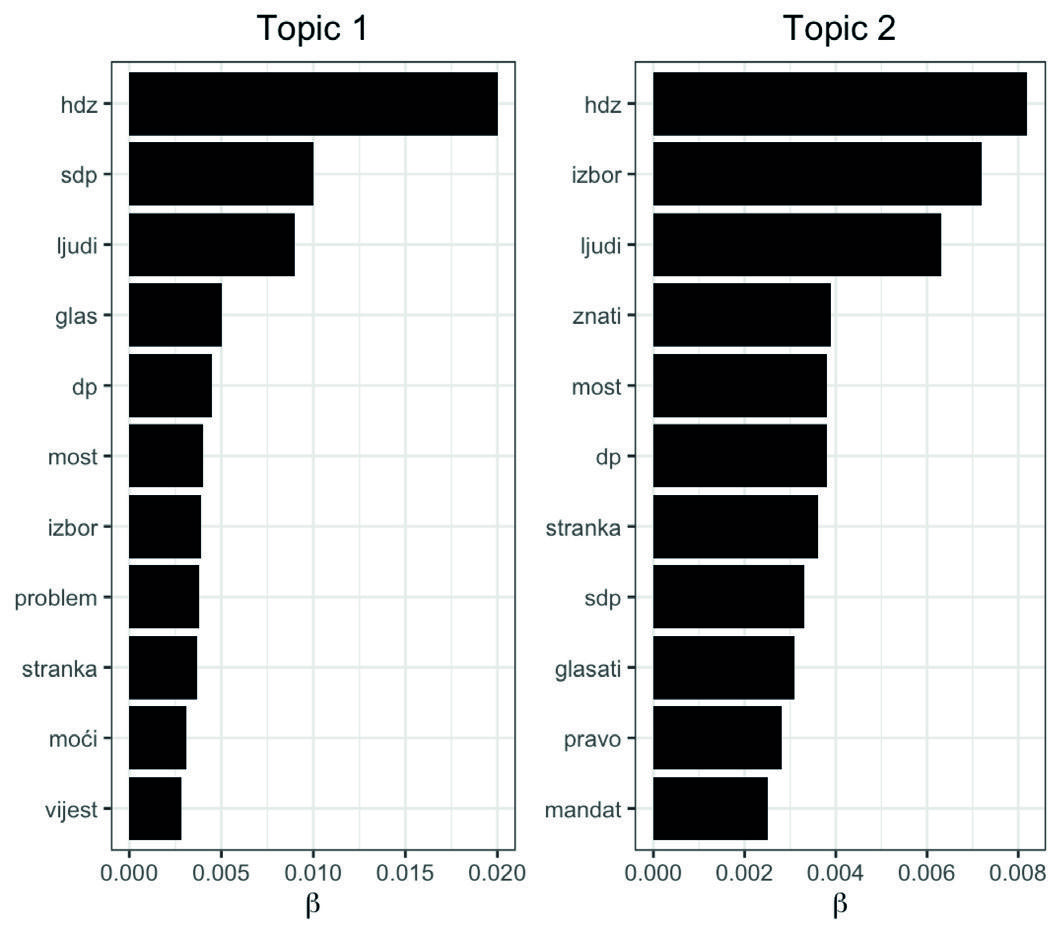
While both clusters discuss elections (izbor, meaning “elections”) and political parties (stranka, “party”), Group 1 places more emphasis on problems (problem), issues with votes (glas, “vote”), and authority (moći, “to be able”). This might indicate that the Group 1 cluster is focused on criticism or problem-oriented discourse, whereas the Group 2 cluster is more about broader electoral topics. Group 2 appears to have a broader spread of terms associated with the election (e.g., izbor – “to vote,” pravo – “right,” mandat – “mandate”), suggesting that it might represent a discussion more focused on procedural or technical aspects of the elections.
Group 1 focuses slightly more on political entities and issues directly linked to political performance or problems, evidenced by the mention of “problem” and a broader distribution of political parties. One cluster may be more focused on HDZ and problems (left cluster), while the other might be more focused on elections and procedural aspects (right cluster).
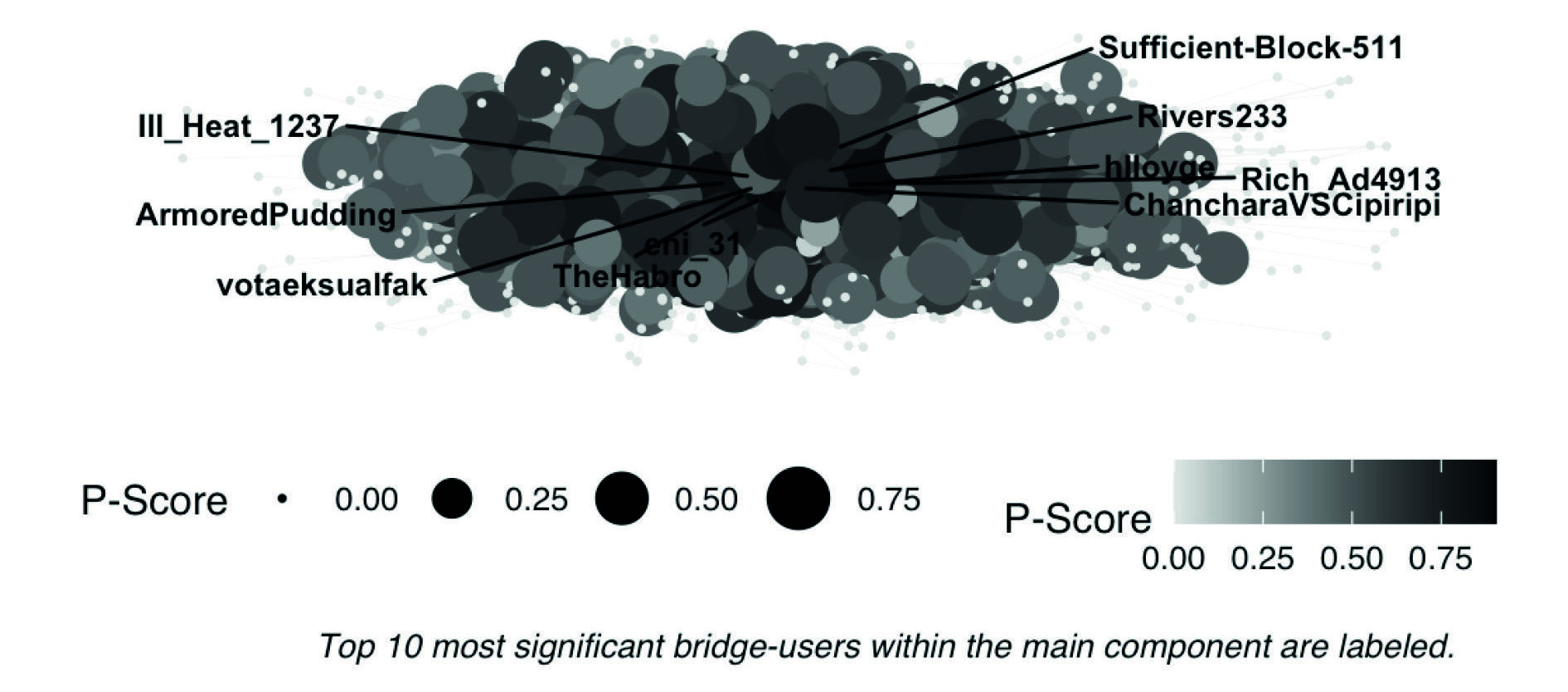
Nine of these top ten “connector” users have r/croatia as their primary subreddit, suggesting that this community is the primary source of cross-community engagement (Table 2).
| User | P-Score | Degree | Primary Subreddit |
|---|---|---|---|
| Party-Cake5173 | 0.906 | 142 | Croatia |
| Glass-Top-5888 | 0.904 | 135 | Croatia |
| CrimsonMutt | 0.904 | 70 | Croatia |
| HistoricCthulhu | 0.903 | 242 | Croatia |
| DaoNight23 | 0.897 | 85 | Croatia |
| External-World8114 | 0.893 | 172 | Croatia |
| votaeksualfak | 0.892 | 132 | Croatia |
| theCha1rmak3r | 0.891 | 76 | Croatia |
| Dalmatinski_Bor | 0.891 | 229 | Croatia |
| Wuhan_Batman | 0.889 | 15 | Croatia |
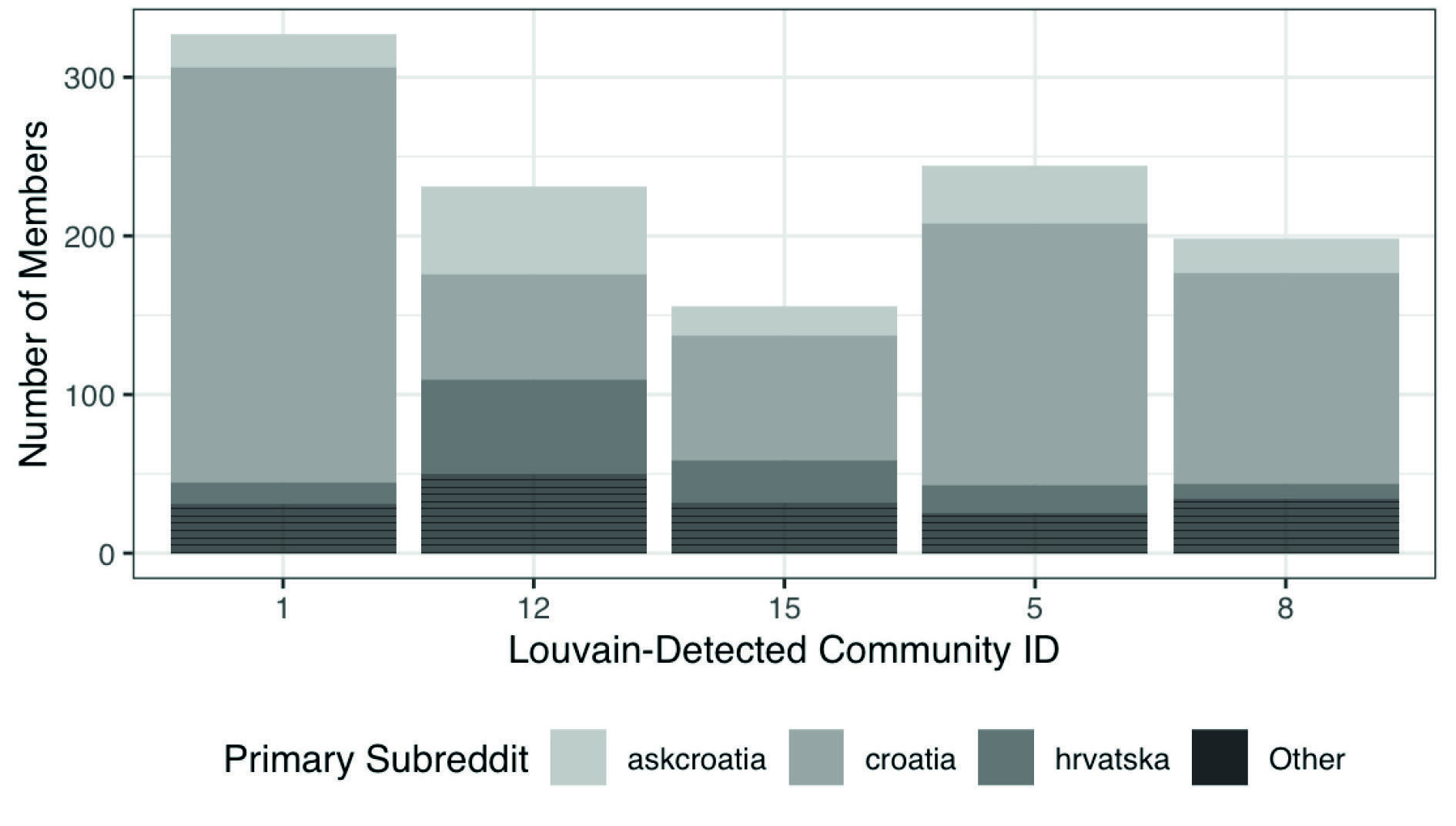
As shown in the visualizations of community composition (Figure 2), each of the largest structural communities is overwhelmingly composed of users from a single subreddit (e.g., r/croatia or r/hrvatska), confirming a homophilous, segregated structure. Content analysis revealed that the major communities were not distinguished by discussing different topics; rather, they were all intensely focused on the same set of core electoral keywords (glas, izbor, polit, HDZ, MOST). However, their emotional tones were markedly different. Sentiment analysis showed a clear variance in negativity across communities.
We also performed an analysis of public sentiment over the observed period. Figure 3 shows significant variations in public mood, with a noticeable spike in positive sentiment during the week of April 8–15, 2024. This increase in positive sentiment can be interpreted as a reaction to the intense media coverage and the final stages of the parliamentary election campaign, which culminated in the elections held on April 17, 2024. During this period, national television networks organized pre-election debates, which may be related to shaping public opinion. This suggests that media presence and direct communication between political figures and the public through debates had a positive influence on public sentiment, possibly due to the emphasis on key issues and the prospect of positive changes that the elections might bring.
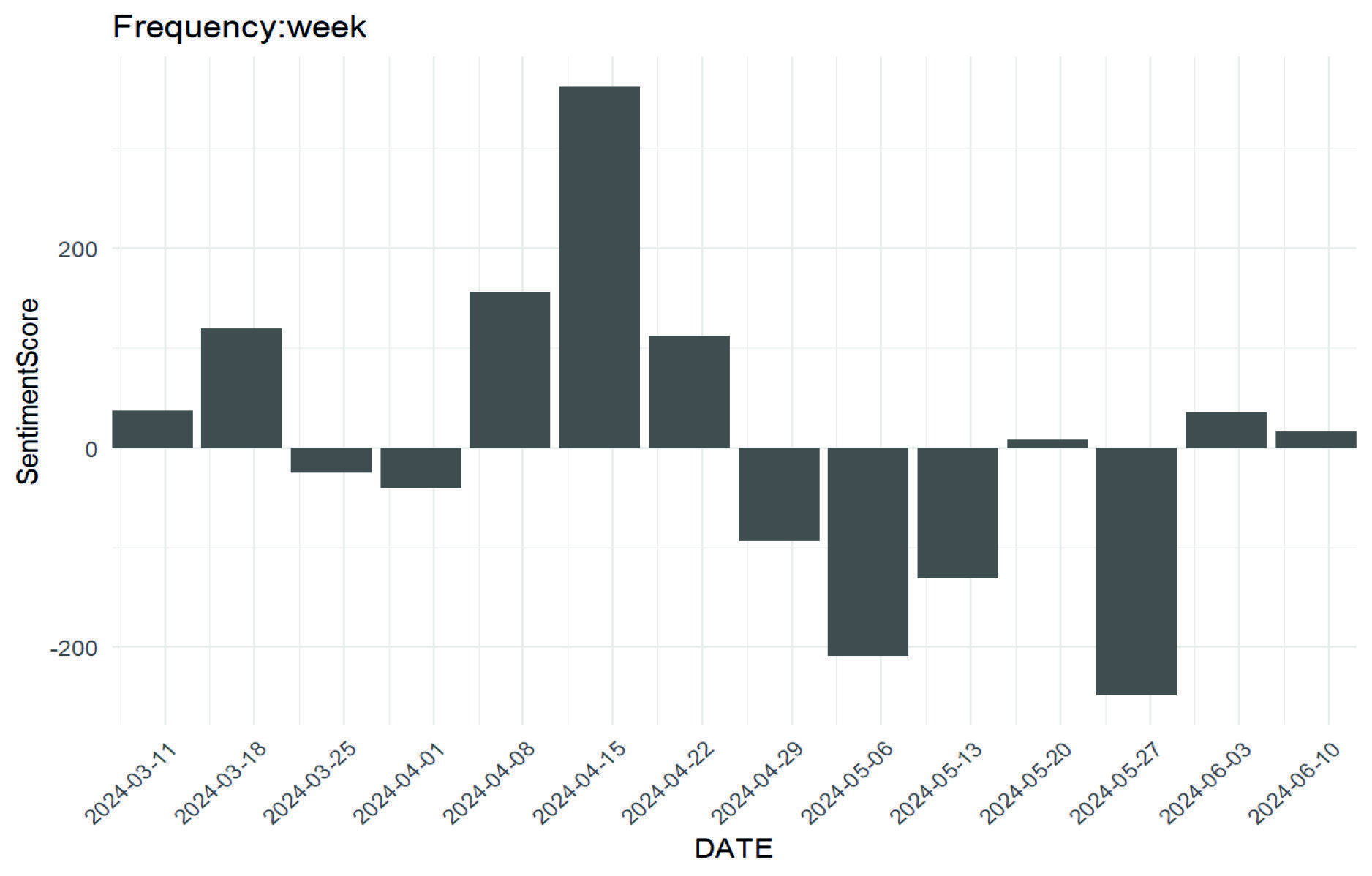
In contrast, negative sentiment was observed during two specific periods: from April 29 to May 6, and again from May 20 to May 27, 2024. These periods are directly correlated with key political events following the election. The first period of negative sentiment coincided with the announcement of the final election results by the State Election Commission on April 29, 2024, while the second wave of negative sentiment began after the formation of a right-centrist coalition government between the HDZ and the more right-leaning DP, which took place on May 17, 2024. These events indicate dissatisfaction among participants in the discussions, which can be interpreted as a reaction to the election outcome and the composition of the new government.
The network analysis revealed a complex network structure characterized by both clear segregation and widespread cross-community engagement. The Louvain algorithm identified 65 distinct communities, with the five largest containing 322, 291, 221, 190, and 171 members, respectively. The network’s modularity score was high (Q = 0.41), indicating a strong, non-random division into dense clusters. Further analysis confirmed that these structural communities align with subreddit boundaries. The assortativity coefficient was positive and significant (r = 0.28), demonstrating a clear tendency for users to interact within their primary subreddit.
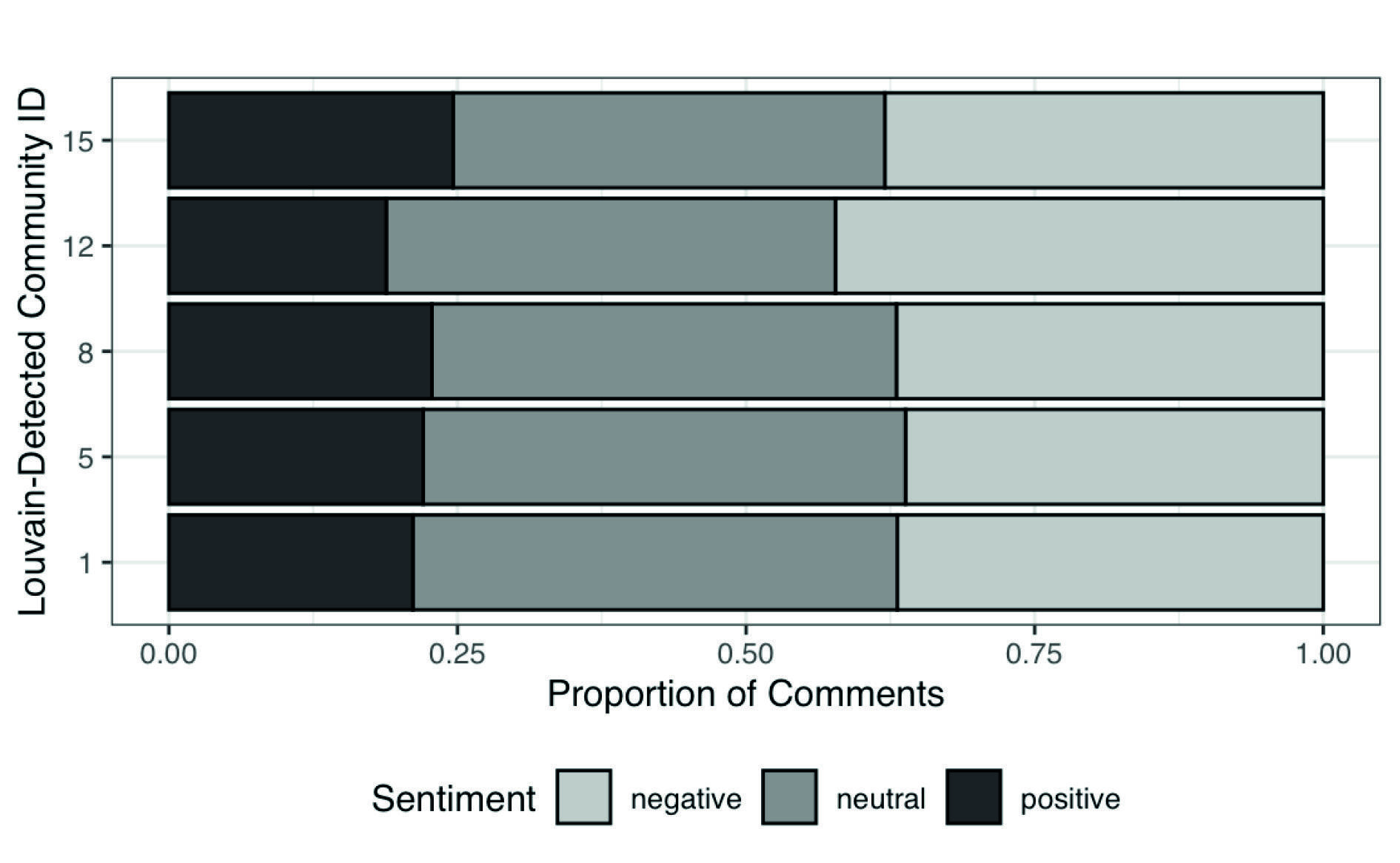
The most critical communities exhibited a negativity rate as high as 46.3%, while the least critical were closer to 37.6% (Figure 4). This indicates that while the subject matter was shared, the framing and emotional response were distinct to each community. One of the most surprising findings is that communities are not divided by the topics they discuss. The same electoral keywords — HDZ, SDP, MOST, izbori, glas — dominate across all major clusters. However, communities differ in how they emotionally frame these topics. Sentiment analysis reveals systematic variation: some communities express frustration and cynicism (up to 46.3% negativity), while others demonstrate comparatively moderate affect. This aligns with Papacharissi’s (2015) concept of affective publics, where shared events produce divergent emotional formations rather than ideological fragmentation. The median participation coefficient (Figure 5) was high (P = 0.53). This finding indicates that the typical user in this network is not a “local” confined to one group, but a “bridge” whose interactions are distributed across multiple communities.
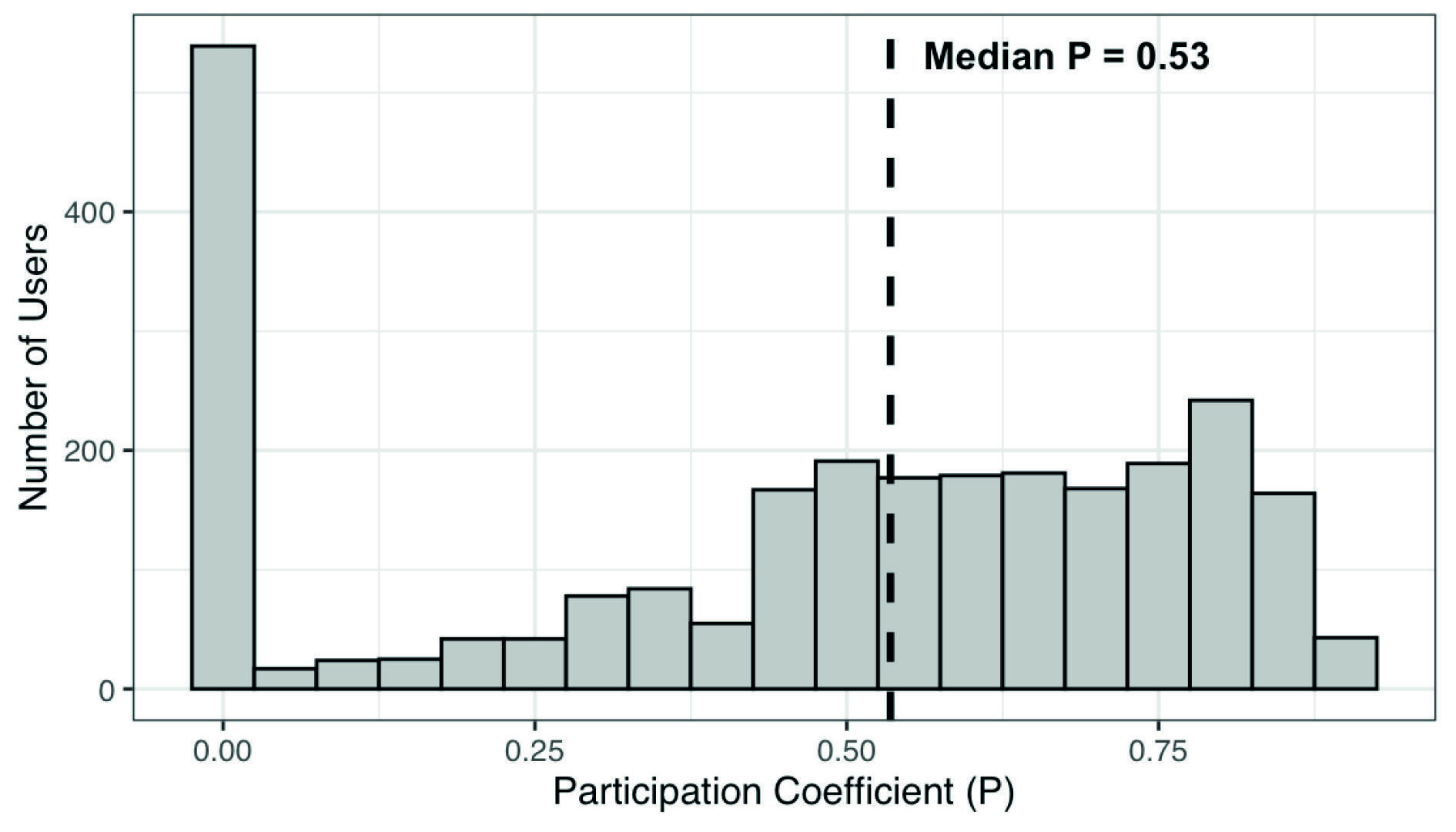
The ten users with the highest P-scores (all > 0.89) are “super-connectors” who are highly active across the ecosystem. Despite structural segmentation, the network is highly integrated at the user level. The median participation coefficient (P = 0.53) indicates that most users engage across multiple communities rather than remaining local to one. The presence of “super-connector” users with extremely high P-scores (> 0.89), most of whom belong to r/croatia, suggests that this subreddit acts as the system’s interactional hub. These users bridge separate subreddits, prompting coordinated debate, intensifying exposure to disagreement, and contributing to the high-conflict environment observed in the network. This “clash” model (Figure 6) reveals a communicative pattern we describe as a clash of communities. We interpret these patterns as a “clash of communities,” understood as an interpretative model describing how structurally distinct groups engage in emotionally differentiated communication around shared issues. Croatian Reddit communities are structurally distinct, yet simultaneously topically aligned, and their interactions are frequently confrontational in tone.
Discussion
The findings of this study provide important insights into how digital publics are structured and experienced within contemporary online environments. Rather than supporting the notion of ideologically isolated echo chambers, the results reveal a more complex communicative configuration in which structurally segmented communities remain interconnected while expressing differences primarily through emotional tone and communicative norms. This pattern suggests that fragmentation in digital environments cannot be fully understood as thematic or ideological separation, but must be approached as a relational and affective phenomenon embedded in communicative practices.
A central implication of these findings is the need to reconsider dominant models of online polarisation. Much of the existing literature conceptualises digital fragmentation as the result of ideological sorting, leading to the formation of homogeneous and isolated communities (Cinelli et al., 2021). However, the present analysis demonstrates that Croatian Reddit communities are not separated by the topics they discuss. On the contrary, all major communities engage with the same core political issues, including elections, political parties, and governance. The network analysis reveals a clearly segmented structure characterised by high modularity and strong subreddit-based clustering. This finding directly answers RQ1, showing that virtual communities are organised as distinct structural clusters that align with platform-based community boundaries while remaining part of a broader interaction network.
What differentiates these communities is not thematic focus, but communicative orientation. Differences emerge primarily in emotional tone, ranging from highly critical and negative expressions to more moderate or procedural styles of discussion. This finding aligns with recent research suggesting that exposure to diverse viewpoints does not necessarily reduce polarisation and may instead intensify disagreement and reinforce group identities (Bail, 2021; Benkler et al., 2018). In this sense, fragmentation does not imply a lack of interaction, but rather a condition in which interaction takes place across persistent symbolic and affective boundaries.
The results therefore support a shift away from viewing digital publics as fragmented into isolated echo chambers toward understanding them as interconnected but differentiated communicative environments. Users do not avoid opposing viewpoints; instead, they encounter them within shared communicative spaces, where differences are expressed through tone, style, and emotional framing rather than through complete thematic separation.
The analysis further demonstrates that emotional communication plays a central role in structuring online communities. While all major communities discuss the same topics, they exhibit distinct affective profiles, characterised by varying levels of negativity and differing communicative styles. This finding provides an answer to RQ2, indicating that communities differ primarily in emotional tone and communicative orientation rather than in thematic focus. These results support the concept of affective publics (Papacharissi, 2015), where collective engagement is shaped not only by shared issues but by shared emotional orientations. Emotional tone functions as a key marker of group identity. Communities with higher levels of negativity appear to cultivate communicative norms centred on critique, frustration, and political dissatisfaction, while others adopt more neutral or procedural styles. These differences are not merely expressive, but have important implications for participation. As previous research suggests, highly negative or confrontational environments may discourage participation among less assertive users or those who do not share the dominant communicative style (Ziegele et al., 2018). In this sense, emotional differentiation contributes to the reproduction of participatory inequalities within digital publics. Also, the findings suggest that differences between communities are not primarily ideological, but normative and affective. Communities interpret and discuss the same political events, yet they do so through distinct emotional repertoires and communicative expectations. This reinforces the idea that identity in digital environments is enacted through communication practices, including tone, style, and emotional expression, rather than solely through explicit ideological positioning.
The network analysis reveals a high degree of cross-community interaction, mediated by users with elevated participation coefficients. These “connectors” play a crucial role in linking otherwise segmented communities, facilitating the circulation of discourse across different subreddits. This finding directly addresses RQ3, demonstrating that bridging users connect structurally separated communities and enable interaction across otherwise distinct communicative spaces. This dynamic aligns with the concept of networked individualism (Wellman, 2001) and with theories of weak ties, which emphasise the importance of bridging connections in enabling information flow across social boundaries. However, the presence of bridging users does not lead to integration or consensus. On the contrary, the results suggest a paradox of connectivity: while communities are structurally connected through overlapping participation, this connectivity does not reduce division, but instead sustains and potentially intensifies it. Exposure to different viewpoints, rather than fostering deliberation, may reinforce identity-based distinctions and contribute to ongoing contestation (Bail, 2021). From this perspective, connectors do not dissolve boundaries, but operate within and across them, enabling interaction without eliminating difference. Their activity contributes to a communicative environment in which users are regularly exposed to alternative perspectives, yet remain anchored in distinct communicative cultures.
Building on these findings, this study proposes the concept of a “clash of communities” as a way of conceptualising the observed communicative configuration. The clash of communities describes a digital environment in which structurally distinct groups engage with shared topics while maintaining differentiated emotional orientations and communicative norms. Unlike the echo chamber model, it does not imply isolation or lack of interaction. Instead, it emphasises the coexistence of segmentation and connectivity. At the same time, the clash of communities differs from deliberative models of the public sphere, which assume that interaction between diverse actors leads to consensus or mutual understanding. In the present case, interaction is characterised by ongoing contestation, where differences are expressed, reinforced, and negotiated without necessarily being resolved. This aligns with agonistic theories of democracy (Mouffe, 2005), which conceptualise public discourse as a space of legitimate conflict between competing positions. The key contribution of this model lies in reconceptualising fragmentation as a product of emotionally differentiated interaction within connected networks, rather than as a result of isolation or ideological segregation.
Conclusion
This study demonstrates that Croatian Reddit communities are structurally segmented yet interconnected, forming digital publics in which fragmentation occurs within a shared communicative space rather than through isolation. While communities engage with the same political topics, they differ primarily in emotional tone and communicative style, highlighting the central role of affective dynamics in shaping participation and boundary formation.
The findings further reveal that bridging users connect otherwise segmented communities, facilitating interaction without leading to consensus. Instead, this connectivity sustains ongoing disagreement, pointing to a paradox of digital communication in which increased interaction may reinforce, rather than reduce, division. Taken together, these results support the concept of a “clash of communities,” describing digital publics as interconnected yet internally differentiated spaces marked by persistent symbolic and affective boundaries.
These findings have broader implications for understanding democratic communication in digital environments. First, they suggest that increasing connectivity and exposure to diverse viewpoints does not automatically lead to more inclusive or deliberative public discourse. Instead, interaction may reinforce differences, particularly when mediated through emotionally charged communication. Second, the results highlight the importance of communicative norms in shaping participation. While digital platforms expand opportunities for engagement, they also generate environments in which certain forms of expression dominate, potentially marginalising users who do not conform to these norms. Finally, the study demonstrates that digital publics should be understood as dynamic and relational systems, where structural organisation, emotional communication, and interaction patterns jointly shape the conditions of participation and the nature of public discourse.
Several limitations of the study should be acknowledged. The dataset was constructed using keyword-based sampling, which may exclude relevant discussions that do not explicitly reference electoral terms. The network analysis captures co-participation rather than direct interaction or agreement, and sentiment analysis may not fully account for contextual nuances such as irony or sarcasm. Furthermore, the findings are specific to the Croatian Reddit context and the selected time period, and should therefore be interpreted with caution when generalising to other settings.
Future research could build on these findings by incorporating qualitative approaches to better understand the interpretative practices of users, particularly those acting as connectors across communities. Longitudinal analyses would also provide insight into how these dynamics evolve beyond periods of heightened political salience. Additionally, comparative studies across different platforms and media systems would further contribute to understanding the role of digital environments in shaping contemporary public discourse.
References
Barberá, P. (2020) ‘Social media, echo chambers, and political polarization’, in Persily, N. and Tucker, J.A. (eds.) Social Media and Democracy. SSRC Anxieties of Democracy. Cambridge: Cambridge University Press, pp. 34–55. DOI: 10.1017/9781108890960.
Baym, N.K. (2010) Personal connections in the digital age. Cambridge: Polity Press. DOI: 10.5771/1615-634X-2011-3-430.
Benkler, Y., Faris, R. and Roberts, H. (2018) Network propaganda: Manipulation, disinformation, and radicalization in American politics. Oxford: Oxford University Press. DOI: 10.1093/oso/9780190923624.001.0001.
Benoit, K., Watanabe, K., Wang, H., Nulty, P., Obeng, A., Müller, S. and Matsuo, A. (2018) ‘quanteda: An R package for the quantitative analysis of textual data’, Journal of Open Source Software, 3(30), p. 774. DOI: 10.21105/joss.00774.
boyd, d. (2010) It’s complicated: The social lives of networked teens. New Haven: Yale University Press. DOI: 10.12987/9780300166439.
boyd, d. (2011) ‘Social network sites as networked publics: Affordances, dynamics, and implications’, in Papacharissi, Z. (ed.) A networked self: Identity, community, and culture on social network sites. New York: Routledge, pp. 39–58. DOI: 10.4324/9780203876527-8.
Brüggemann, M. and Meyer, H. (2023) ‘When debates break apart: discursive polarization as a multi-dimensional divergence emerging in and through communication’, Communication Theory, 33(2–3), pp. 132–142. DOI: 10.1093/ct/qtad012.
Castells, M. (2012) Networks of outrage and hope: Social movements in the internet age. Cambridge: Polity Press.
Cinelli, M., De Francisci Morales, G., Galeazzi, A., Quattrociocchi, W. and Starnini, M. (2021) ‘The echo chamber effect on social media’, Proceedings of the National Academy of Sciences, 118(9), e2023301118. DOI: 10.1073/pnas.2023301118.
Fraser, N. (1990) ‘Rethinking the public sphere: A contribution to the critique of actually existing democracy’, Social Text, (25/26), pp. 56–80. DOI: 10.2307/466240.
Freelon, D. (2015) ‘Discourse architecture, ideology, and democratic norms in online political discussion’, New Media & Society, 17(5), pp. 772–791. DOI: 10.1177/1461444813513259.
Gaudette, T., Scrivens, R., Davies, G. and Frank, R. (2021) ‘Upvoting extremism: Collective identity formation and the extreme right on Reddit’, New Media & Society, 23(12), pp. 3491–3511. DOI: 10.1177/1461444820958123.
Glavaš, G., Šnajder, J. and Dalbelo Bašić, B. (2012) ‘Semi-supervised acquisition of Croatian sentiment lexicon’, in Sojka, P. et al. (eds.) Text, Speech and Dialogue. Berlin: Springer, pp. 166–173. DOI: 10.1007/978-3-642-32790-2_20.
Habermas, J. (2006) ‘Political communication in media society’, Communication Theory, 16(4), pp. 411–426. DOI: 10.1111/j.1468-2885.2006.00280.x.
Habermas, J. (2022) ‘Reflections and hypotheses on a further structural transformation of the political public sphere’, Theory, Culture & Society, 39(4), pp. 145–171. DOI: 10.1177/02632764221112341.
Kotowski, M.R. and Dos Santos, G.M. (2010) ‘The role of the connector in bridging borders through virtual communities’, Journal of Borderlands Studies, 25(3–4), pp. 150–158. DOI: 10.1080/08865655.2010.9695777.
Kunić, T. (2024) Participatory journalism and reader comments in Croatia. Lanham: Lexington Books. DOI: 10.5771/9781666921991.
Lamont, M. and Molnár, V. (2002) ‘The study of boundaries in the social sciences’, Annual Review of Sociology, 28, pp. 167–195. DOI: 10.1146/annurev.soc.28.110601.141107.
Ljubešić, N., Klubička, F., Agić, Ž. and Jazbec, J. (2016) ‘New inflectional lexicons and training corpora for improved morphosyntactic annotation of Croatian and Serbian’, in Calzolari, N. et al. (eds.) Proceedings of the 10th International Conference on Language Resources and Evaluation (LREC 2016). Paris: ELRA, pp. 4264–4270.
Marjanović, D. (2025) ‘Zajednice posvećene lokalnom identitetu na Facebooku. Istraživački put kroz “Digitalni zavičaj – jakovlje.com”’, Medijska istraživanja, 31(2), pp. 73–108. DOI: 10.22572/mi.30.2.3.
Marwick, A.E. and boyd, d. (2011) ‘I tweet honestly, I tweet passionately: Twitter users, context collapse, and the imagined audience’, New Media & Society, 13(1), pp. 114–133. DOI: 10.1177/1461444810365313.
Mouffe, C. (2005) On the political. London: Routledge. DOI: 10.4324/9780203870112.
Mouffe, C. (2013) Agonistics: Thinking the world politically. London: Verso.
Papacharissi, Z. (2015) Affective publics: Sentiment, technology, and politics. Oxford: Oxford University Press. DOI: 10.1093/acprof:oso/9780199999736.001.0001.
Peruško, Z., Vozab, D. and Čuvalo, A. (2020) Comparing post-socialist media systems: The case of Southeast Europe. London: Routledge. DOI: 10.4324/9780367226787.
Prinster, G.H., Smith, C.E., Tan, C. and Keegan, B.C. (2024) ‘Community archetypes: An empirical framework for guiding research methodologies to reflect user experiences of sense of virtual community on Reddit’, Proceedings of the ACM on Human-Computer Interaction, 8(CSCW1), pp. 1–33. DOI: 10.1145/3637310.
Selivanov, D. and Wang, Q. (2016) text2vec: Modern text mining framework for R. R package version 0.4.0. Available at: https://CRAN.R-project.org/package=text2vec.
Silge, J. and Robinson, D. (2017) Text mining with R: A tidy approach. Boston: O’Reilly.
Soliman, A., Hafer, J. and Lemmerich, F. (2019) ‘A characterization of political communities on Reddit’, in Proceedings of the 30th ACM Conference on Hypertext and Social Media (HT ’19). New York: ACM, pp. 259–263. DOI: 10.1145/3342220.3343662.
Treen, K., Williams, H.T.P., O’Neill, S.J. and Coan, T.G. (2022) ‘Discussion of climate change on Reddit: Polarized discourse or deliberative debate?’, Environmental Communication, 16(5), pp. 680–698. DOI: 10.1080/17524032.2022.2050776.
Wellman, B. (1999) ‘The network community: An introduction’, in Wellman, B. (ed.) Networks in the global village. Boulder: Westview Press, pp. 1–47. DOI: 10.4324/9780429498718-1.
Wellman, B. (2001) ‘Physical place and cyberplace: The rise of personalized networking’, International Journal of Urban and Regional Research, 25(2), pp. 227–252. DOI: 10.1111/1468-2427.00309.
Wellman, B. and Gulia, M. (1999) ‘Virtual communities as communities: Net surfers don’t ride alone’, in Smith, M.A. and Kollock, P. (eds.) Communities in cyberspace. London/New York: Routledge, pp. 167–194. DOI: 10.4324/9780429498718-11.
Ziegele, M., Breiner, T. and Quiring, O. (2017) ‘What creates interactivity in online news discussions?’, Journalism Studies, 18(4), pp. 1–19. DOI: 10.1111/jcom.12123.
Ziegele, M., Weber, M., Quiring, O. and Breiner, T. (2018) ‘The dynamics of online news discussions: Effects of news articles and reader comments on users’ involvement, willingness to participate, and civility’, Information, Communication & Society, 21(10), pp. 1411–1428. DOI: 10.1080/1369118X.2017.1324505.
Sažetak
Povezani, ali podijeljeni: afektivne javnosti i sukob zajednica na hrvatskom Redditu u kontekstu izbora 2024. godine
Digitalne platforme identificiramo kao neformalne prostore sudjelovanja, u kojima građani pregovaraju o pripadnosti, izražavaju društvene identitete i sudjeluju u javnoj raspravi. Ovaj rad istražuje hrvatske virtualne zajednice na Redditu kao digitalnu javnu sferu koja odražava šire obrasce društvene kohezije, isključenosti i participacijskih nejednakosti. Polazeći od teorija virtualnih zajednica i umreženih javnosti, rad analizira kako hrvatske Reddit zajednice komuniciraju, konstruiraju granice i iskazuju kolektivne identitete kroz izražavanje sentimenta tijekom razdoblja velikih društvenih događaja — parlamentarnih izbora i izbora za Europski parlament 2024. godine. U radu je korištena analiza mreže, analiza sentimenta i tematsko modeliranje na uzorku od 11.503 komentara prikupljenih između ožujka i lipnja 2024., kako bi se istražilo kako se zajednice međusobno povezuju, razilaze i kako premošćuju razlike. Rezultati pokazuju da, iako zajednice raspravljaju o istim društveno relevantnim temama, one se značajno razlikuju u emocionalnosti, što odražava afektivnu dinamiku karakterističnu za suvremene digitalne javnosti. Strukturnu segmentaciju prate različite razine negativnosti, što može obeshrabriti određene korisnike na sudjelovanje te tako dodatno pojačati nejednakosti unutar virtualnih prostora. Isto tako, primijećeno je kako mala skupina “konektora” sudjeluje u više zajednica, ukazujući na ograničen, ali važan potencijal za komunikaciju u fragmentiranom digitalnom okruženju. Taj koncept autori istraživanja nazivaju “interakcijski sudar zajednica” te ga definiraju kao identitetski uvjetovanu konfiguraciju u kojoj zasebne skupine ostaju odvojene, ali se neprestano uključuju u emocionalno nabijene interakcije. Rezultati ovog istraživanja naglašavaju važnost poticanja inkluzivnih komunikacijskih praksi te prepoznavanja emocionalnih dinamika kao ključnih čimbenika koji oblikuju društvenu koheziju i demokratsko sudjelovanje u suvremenim digitalnim okruženjima.
Ključne riječi: virtualne zajednice; komentari korisnika; komunikacija; interakcijski sudar zajednica; Reddit